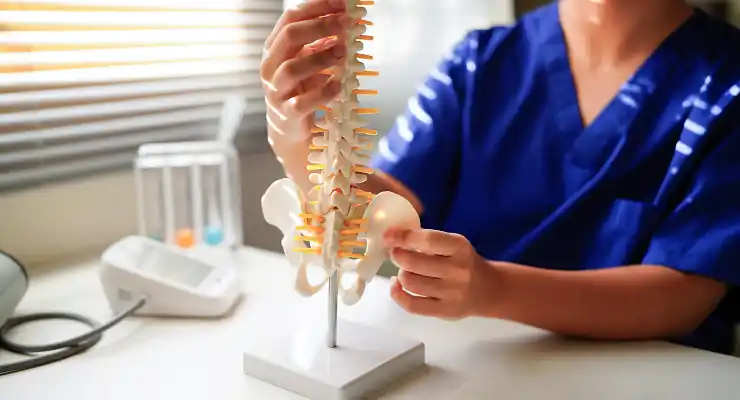
Your spine is made up of a series of bones called vertebrae, stacked on top of each other with soft, cushion-like structures between them called intervertebral discs. These discs act as shock absorbers, help distribute pressure across the spine, and allow for movement and flexibility. Each disc has a tough outer layer called the annulus fibrosus and a softer, gel-like center called the nucleus pulposus.
When something disrupts the normal shape or structure of a disc, it can result in either a bulging or herniated disc. Both conditions are among the most common reasons people experience back and neck pain, and both can affect your quality of life if they begin to put pressure on nearby nerves. The good news is that many people with disc changes visible on imaging scans have no symptoms at all, which means a diagnosis does not always have to feel alarming. Understanding what is happening in your spine is the first step toward making informed decisions about your health.

While the terms "bulging disc" and "herniated disc" are often used interchangeably, they actually describe two distinct types of disc changes.
A bulging disc occurs when the outer edge of the disc extends beyond its usual boundary in a broad, widespread way, typically involving more than a quarter of the disc's circumference. Think of it like a hamburger patty that is slightly too big for its bun and spills out evenly around the edges. A bulging disc does not necessarily mean the outer layer has broken, and it is an extremely common finding on imaging scans, even in people with no pain.
A herniated disc refers to a more localized, focal displacement of disc material beyond the normal disc boundary, typically involving less than a quarter of the disc's circumference. This can happen when the inner core pushes through a crack or tear in the outer layer. Herniated discs are sometimes described in further detail:
An important thing to understand is that neither a bulge nor a herniation automatically causes pain. Symptoms tend to occur only when displaced disc material compresses or irritates a nearby nerve root or the spinal cord. This is why two people with nearly identical imaging results can have very different experiences.
Disc changes rarely happen overnight. In most cases, they develop gradually as a result of a combination of factors.
Symptoms depend heavily on where in the spine the disc change occurs and whether any nerves are being affected.
In the lower back (lumbar spine), you might experience:
In the neck (cervical spine), symptoms may include:
It is worth noting that many people discover they have a bulging or herniated disc only incidentally, during imaging for an unrelated concern. Disc findings on scans are common in adults of all ages and do not always explain or cause pain.
Anyone can develop a herniated or bulging disc, but certain factors increase the likelihood.
A herniated disc always causes severe pain. Not true. Many people have herniated discs with no pain or only mild discomfort. Symptoms depend on whether nerves are affected, not simply on the disc change itself.
If imaging shows a disc problem, intervention is immediately necessary. Imaging findings need to be matched with your symptoms and physical exam. A disc change on a scan is not automatically a problem requiring urgent action.
A "slipped disc" means the disc has moved out of place. This is a common but misleading phrase. Discs do not actually slip out from between the vertebrae. The term describes a bulge or herniation in informal language.
Bed rest is the best response to disc pain. Extended rest can actually slow recovery. Staying gently active within a comfortable range is generally more beneficial than prolonged inactivity.
Disc damage is permanent. The body has some capacity to reabsorb herniated disc material over time, and many people experience significant improvement without intervention.
Diagnosis typically starts with a thorough health history and physical examination. A healthcare provider will ask about the location, nature, and timing of your symptoms, as well as what makes them better or worse.
During a physical examination, the provider may assess:
Imaging is often used to confirm or clarify findings. MRI is the most detailed option for evaluating disc structure, nerve involvement, and soft tissue. X-rays can provide information about bone alignment and spacing. A CT scan may be used in certain cases.
One important point is that imaging results must always be interpreted alongside your symptoms and physical exam. An abnormal finding on a scan does not automatically mean that finding is responsible for your pain.
You should contact a healthcare provider if you experience:
Seek immediate care if you experience:
These symptoms can indicate a rare but serious condition called cauda equina syndrome and require urgent evaluation.